Artifact 1 - Roman Holiday Cover
Recording and Mixing
Why I Chose This Song:
For this artifact I chose to record and mix Roman Holiday by Fontaines D.C. I chose this song as I am a massive fan of the band and this song overall. I believe that the individual instruments in this song are extremely unique sounding and would be amazing to try recreating with the great facilities that we have at NCL.
Planning Stage:
As I am within a large class of people all looking to use the studios to complete their recordings I had to plan out what my approach to recording this song so I could get the most out of the time that I have to complete this project. I knew I would be starting the recording process with the drums and after listening over the song I knew that it was quite a dry drum sound, the audient was a perfect room for this sound as it is padded which means dryer acoustics. We also wanted to record using a musician who is external to the college so I asked my friend and drummer of my band David Macaulay to provide a steady beat behind the kit.
Secondly I would be recording the electric guitar with a close mic, SSL 1 or 2 would be perfect for this. We went with SSL 1 as it was free the day that we wanted to record it. Following on from the drums we had Cailan McCluskey play the electric guitar part.
On bass we did it the same day as the guitar using similar microphones and within the same studio, played by myself.
Vocals were a struggle to get as I tried them out myself but wasn’t happy with the results, after a while of sitting over the mix I knew that the end product would be better if I had someone with a voice more suited to this style so my friend and bandmate Jamie Gillan came into the studio to record vocals for me.
Recording Process:
Drums:
Creating the dry drum sound of Roman Holiday was essential to this project and the process started before the microphones were even set up. Choosing the Audient ‘dead’ room provided us with the correct sound that we wanted but it also could have caused us issues if we weren’t prepared. With the dryness of the room the sound has nowhere to go and therefore unwanted sounds from unused parts of the kit can be a huge problem, so we removed all the parts of the kit that David wouldn’t be using leaving him with just simply a Kick, Snare, Hi-Hat, Crash and Ride.
In terms of microphone choice, we wanted to fully experiment with as many mics as we thought it would be useful for our progression in this course since we had only recorded simple four microphone setups before this project. For the Kick drum alone we triple mic’d it with a Solomon Sub-mic, AKG D112 and a Shure 91a providing us with a lot of options for mixing. Snare top and bottom were both recorded with a Shure SM57. Overheads were recorded with two AKG 414’s in spaced pair allowing us to get a stereo image of the drums. The Hi-hat was recorded with a AKG 451, so too was the tambourine which was recorded after the drums for an extra added texture.
Vocals:
For the vocals we tried to record them several times but the people we chose didn’t have a voice that suited the track so I called upon the lead singer of my band Jamie Gillan as I knew he was also a fan of the song and has a great voice suited for the style of Fontaines D.C.
To record this vocal performance we used a Neumann TLM 103 with a vocal reflection filter and a pop filter placed in front in order to get a dry vocal performance with reduced pops. The vocal performance was then recorded going through the Empirical Labs Distressor at a 4:1 ratio with a release around 3 and the attack around 5-6, this allowed for a more consistent level of the vocals as any dynamic peaks would be controlled by the compressor. I also added some temporary reverb to Jamie’s liking, as it usually provides for a better vocal performance.
Electric Guitar:
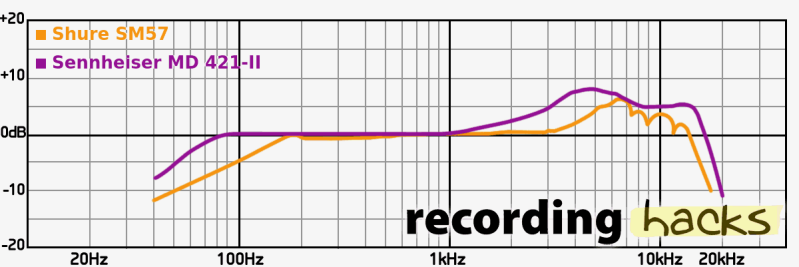
The guitar was recorded close miked, on-axis of the speaker cone with both a Shure SM57 and a Sennheiser MD421 to provide a balanced tone. The SM-57 was able to capture the high-mid frequencies that the MD421 would miss, whereas the MD421 would capture the Low-Mid frequencies that the SM-57 would miss. This gave me plenty of room to choose what tone I want to lean into more when I get to the mixing stage. Close miking also provided me with a dryer recording, also giving me control when getting to the mixing stage as it reduces the room reflections that would be captured otherwise.

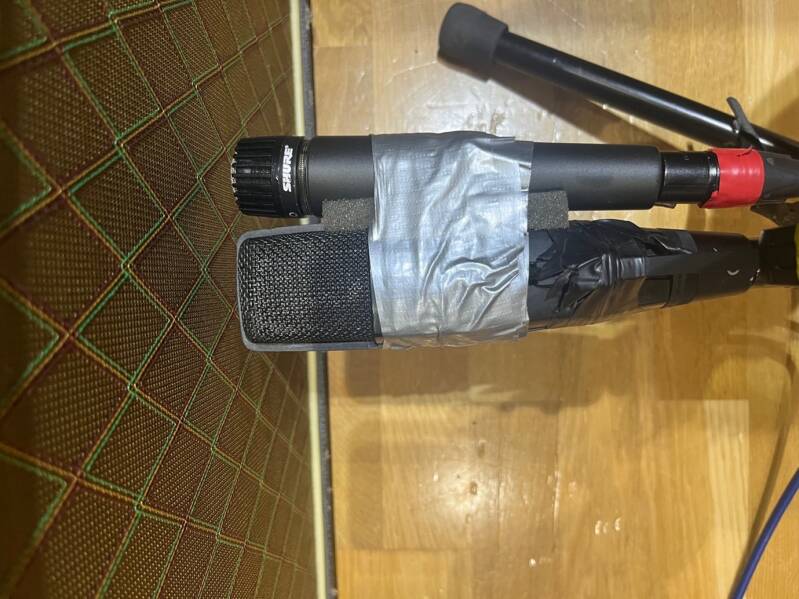
After setting up the microphones we built a pedal setup that we could tweak to match a similar tone to the guitar on the recording, the pedals we used are as follows: Boss Super Overdrive SD-1, Maxon Overdrive OD808, Boss Space Echo RE-202, TC Electronic Skysurfer Reverb and an MXR dyna comp. We set up a the re-amp boxes so that our guitarist Cailan could comfortably sit in the control room to play guitar while the Vox AC15s volume is extremely loud in the live room, a D.I. box was set up too in case of the need to run the signal back through the amp and re-record the same session.

Bass Guitar:
The bass was recorded straight after the guitar as I could run it through line of pedals, di and re amp box. From the pedals that we used on the guitar I only used the MXR dyna comp for this recording as it would provide me with a consistent recording level, I also used a plectrum instead of usually playing with my fingers, this also proved for a more consistent recording level.
The bass was ran into a Fender Rumble 100 and a D.I. signal was also recorded. I used a Shure SM-57 as the microphone which was placed on axis with the speaker cone.
Acoustic Guitar:
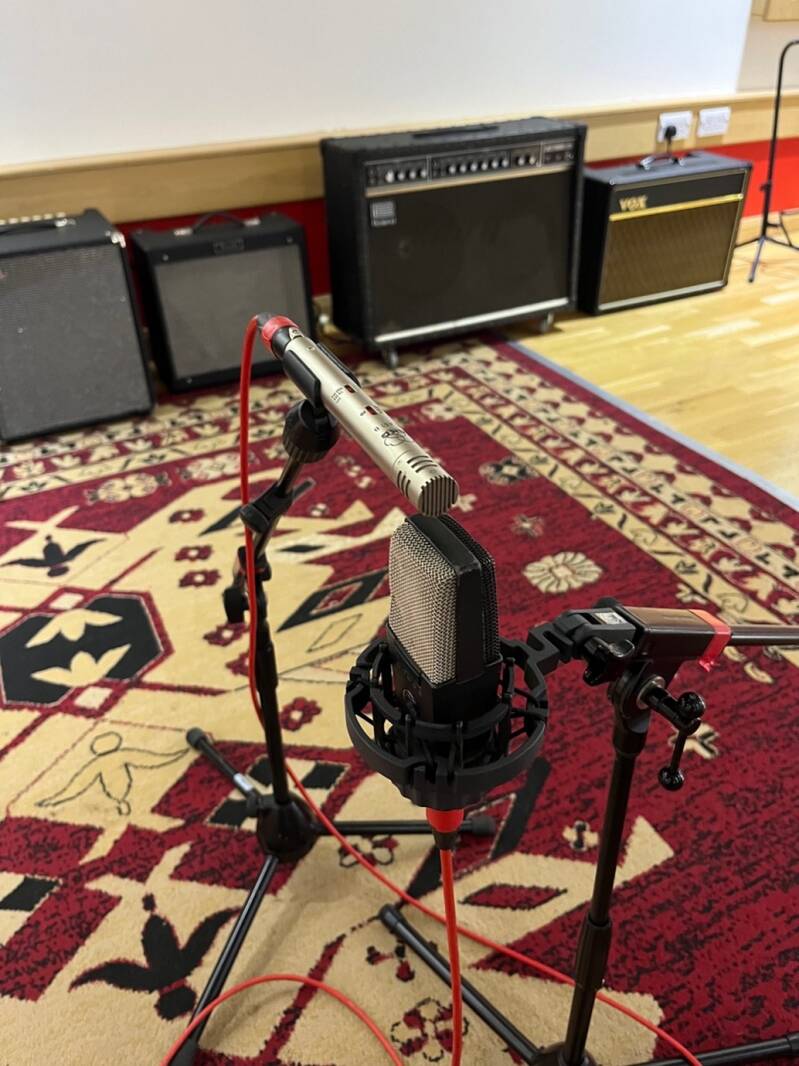
After recording the drums we had time to complete a rough recording of the acoustic guitar using two AKG 414’s in spaced pair recorded in the audient. This track was okay at best and was useful to fill out the mix so the rest of the people recording could have something to play along to but I knew we could do better. After chatting to my lecturer Jim Neilson about having the acoustic guitar play throughout the whole song but have it fill out the mix when the breakdown happens around 2 minutes 50s, he suggested I record with a mid-side technique from which I can increase the volume of the “side” recording when it gets to the breakdown in order to provide the track with a wider stereo image of the guitar.
I recorded the “mid” with an AKG 451 pointed around about the 14th fret of the guitar and the “side” was recorded with an AKG 414 in a figure 8 polar pattern. To get the full “mid-side” effect I had to create and record into two channels for the 414/side recording and flip the phase of one of them using Trim on ProTools. In the mixing stage I could then use volume automation to increase the stereo image of my acoustic guitar.
Mixing Stage
For the mixing stage I planned to get as close to the original recording as possible.
Drums:
Starting with the drums for mixing we firstly ran the signal of the three kick drum recordings through the Empirical Labs Distressor in order to add punch, control of the dynamics and improve its overall presence in the full mix. We also ran the top and bottom snare recordings through the compressor to provide it with the same presence. This was my first time using the outboard gear to mix something and it was a brilliant learning curve.
In terms of plugins for the kick and snare I only applied some EQ to the "kick out" recording to boost some of the low end as the punchiness of this recording is something that I really liked, overall the eq'ing of the kick drum was mostly applied through the volume faders of each recording since we had a sub, kick-in and kick out recording which covers the full frequency range that we needed to work with.
For the snare we applied some spring reverb to an aux track allowing me to fade in how much wet/dry signal I would like. I then applied parallel compression and saturation in order to thicken the body of the snare and allow the detailed rolls/ghost notes to cut through the mix even when it gets busy. I also boosted the snare top at 4khz by 3dB with a wide Q'd bell curve, this also made the snare rolls/ghost notes stand out within the mix.
On the full kit I applied Reel Tape Saturation and a buss compressor which added a warmth to the full kits sound and helped everything feel glued together.
Electric Guitar:
As we had already got the tone of guitar that we were looking for the mixing stage for the electric guitar only took a small amount of tweaking of EQ, taking out the low frequencies with a high pass filter to make the mix less muddy and scooping out some of the harshness that was present around 5k.
I then ran the guitar recording to a stereo aux and applied stereo effects such as spring reverb and delay, this gave the guitar some size, making it stand out in the mix and giving it the presence this part deserves to have.
Bass:
For the bass I hadn't quite recorded the correct tone that I was looking for and I had only noticed this at the recording stage. The original bass I recorded was more muffled and had a lot of low end in comparison to the bass that Fontaines D.C. recorded which had more treble, was punchier and could cut through the mix much better.
In order to fix this issue I applied saturation to an aux track routed from the bass D.I. track , using the Fabfilter Saturn plugin and I also used ProQ to select the frequency of that track that I want to hear more of in the mix. In this case it was around 1k that I wanted to increase, giving the bass more of a treble/thinner tone.
Acoustic Guitar:
The acoustic guitars were simply EQ'd, adding a small shelf of less than 5dB to the mid recording from around 600hz to 20k. For the side recordings I took out a shelf of about -3dB from 10kHz.
If I was to work on acoustic guitars for a session like this again I would probably experiment with reverb, distortion and saturation.
Vocals:
For the vocals I added a slight bit more compression within the mixing stage which was ontop of the compression that I applied through the outboard gear during recording. Delay and reverb were added to an aux track for the vocals to add some space and ambience to the performance. The reverb helped the vocals sit well in the mix, blending this performance well with the other instruments. The delay added some texture to the mix, making the sound of the vocals more impactful and feel larger.
Create Your Own Website With Webador